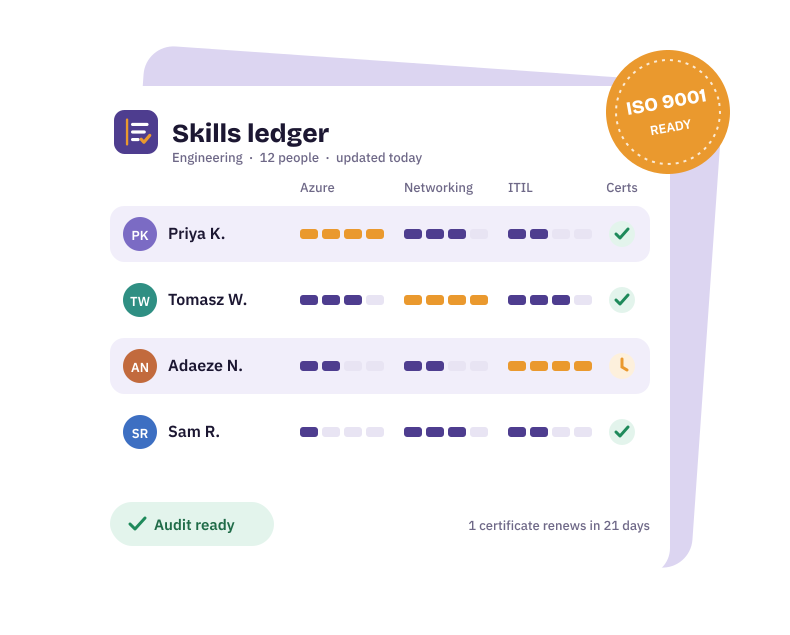
Every example below uses the same 0 to 4 scale: 0 none, 1 aware, 2 practitioner (works independently), 3 advanced, 4 expert (can train others). Names are illustrative.
1. IT support team
IT teams mix technical skills with vendor certifications that expire, so the matrix needs both.
| Person | Microsoft 365 admin | Networking | Endpoint security | Scripting | MS-102 cert |
|---|---|---|---|---|---|
| Asha | 4 | 2 | 3 | 3 | Held, expires Mar |
| Ben | 3 | 1 | 2 | 0 | Held, expires Nov |
| Chloe | 2 | 4 | 2 | 2 | Not held |
| Dev | 2 | 0 | 1 | 1 | Not held |
What it reveals: networking depends entirely on Chloe, and both certified people renew within a few months of each other. If a partner programme needs two certified staff, one late renewal puts the tier at risk. More on that in partner certification tracking.
Typical skills to include: Microsoft 365, Entra ID, Windows Server, networking, firewalls, endpoint security, backup and recovery, scripting (PowerShell), ITIL processes, customer communication, plus vendor certifications from Microsoft, AWS, Cisco and others.
2. Engineering and manufacturing
On a production floor the matrix often doubles as a training matrix: who is signed off to run which machine, and whose safety tickets are current.
| Person | CNC lathe | Press brake | Quality inspection | Forklift licence | First aid |
|---|---|---|---|---|---|
| Emma | 4 | 2 | 3 | Held | Held |
| Frank | 3 | 3 | 1 | Held | Expired |
| Grace | 1 | 4 | 2 | Not held | Not held |
| Hamid | 2 | 0 | 4 | Held | Held |
What it reveals: only Grace is advanced on the press brake, Frank's first aid certificate has lapsed, and quality inspection leans heavily on Hamid. For ISO 9001 sites, the same data is your evidence of competence; see ISO 9001 competence records.
Typical skills to include: each machine or process, setting and changeover, quality inspection, reading drawings, lean or 5S, maintenance tasks, and tickets such as forklift, first aid, manual handling and working at height.
3. Sales team
Sales matrices are mostly behavioural and product knowledge, so clear level descriptions matter even more.
| Person | Prospecting | Discovery calls | Negotiation | Product A | CRM use |
|---|---|---|---|---|---|
| Isla | 3 | 4 | 3 | 2 | 3 |
| Jack | 4 | 2 | 1 | 3 | 2 |
| Kemi | 2 | 3 | 4 | 4 | 4 |
What it reveals: Jack fills the pipeline but struggles to close; pairing him with Kemi on negotiation is a cheaper fix than an external course.
Typical skills to include: prospecting, discovery, presenting, objection handling, negotiation, account management, forecasting, CRM use, and product or sector knowledge.
4. Finance team
| Person | Month-end close | VAT returns | Management accounts | Excel modelling | Payroll |
|---|---|---|---|---|---|
| Leah | 4 | 3 | 4 | 3 | 1 |
| Mo | 3 | 4 | 2 | 2 | 0 |
| Nina | 2 | 1 | 1 | 4 | 4 |
What it reveals: payroll is a single point of failure, which is a real risk if Nina is off when payroll is due. Cross-training Mo is the priority. (More on that in upskilling, reskilling and cross-skilling.)
Typical skills to include: month-end close, reconciliations, VAT, management accounts, budgeting and forecasting, payroll, credit control, the finance system, and Excel modelling.
What good examples have in common
- Skills per team. Each matrix holds only the skills that team needs, rather than one company-wide list.
- Certificates are separate from ratings. Held or not held, with an expiry date.
- The matrix leads to an action. Every example ends with a decision: train, cross-skill, renew or hire. That's a skills gap analysis in miniature.
Our free Excel skills matrix template uses the same 0 to 4 scale and works out the gaps for you. Or try the live version: SkillsLedger includes ready-made skill packs for IT, finance, sales and more in its Skills Library.