Why skills assessment is hard
Every skills matrix and gap analysis depends on the ratings behind it. If those ratings are inflated, inconsistent or out of date, every decision built on them is too. The aim isn't perfect precision: it's ratings that are consistent enough to compare and current enough to act on.
Skills assessment methods
| Method | Good for | Watch out for |
|---|---|---|
| Self-assessment | Coverage and speed; people know their own work | Optimism, modesty, and different interpretations of the scale |
| Manager review | Correcting self-ratings; consistency within a team | Managers who don't see the detail of the work |
| Peer review / 360 | Behavioural skills like communication and teamwork | Time-consuming; can turn political |
| Practical observation | Hands-on and safety-critical tasks | Needs a trained assessor and time on the floor |
| Tests and exercises | Knowledge-based and technical skills | Tests knowledge, not always day-to-day performance |
| Certificates and qualifications | Objective proof; often required for compliance | Proves someone passed once, and they expire |
The practical approach: self-assessment plus manager sign-off
For most organisations, the best balance of effort and accuracy is:
- People rate themselvesAgainst a shared scale with clear descriptions. It's quick, and it gets everyone engaged.
- Managers reviewThe line manager confirms or adjusts each rating, ideally in a short conversation rather than silently.
- Evidence for what mattersFor safety-critical or audited skills, back the rating with a certificate, an observed sign-off or a test.
- Re-rate regularlyAt least twice a year, and after any training, so the data stays current.
A rating scale you can use
A short scale with behavioural descriptions beats a long numeric one. The 0 to 4 scale we use in our free template:
| Level | Name | Description |
|---|---|---|
| 0 | None | No knowledge or experience yet. |
| 1 | Aware | Understands the basics and can help with guidance. |
| 2 | Practitioner | Does the work independently to the expected standard. |
| 3 | Advanced | Handles complex or unusual cases and reviews others' work. |
| 4 | Expert | The go-to person; can train and assess others. |
Why describe behaviour rather than use "good" or "very good"? Because "can do it independently" means the same thing to everyone; "good" doesn't. If a specific skill needs it, add a one-line example of what each level looks like for that skill.
How to keep ratings honest
- Separate it from pay and performance reviews. If ratings affect bonuses, they drift upwards. Say clearly that the matrix is for planning.
- Calibrate managers. Get managers to compare a few ratings across teams so a "3" means the same in every department.
- Make "0" safe. Not having a skill isn't a failure; it's information the team needs.
- Let people flag interest. Someone rated 1 who wants to learn is a better training candidate than someone rated 2 who doesn't.
- Keep it short. Fifteen relevant skills get honest answers; a hundred get box-ticking.
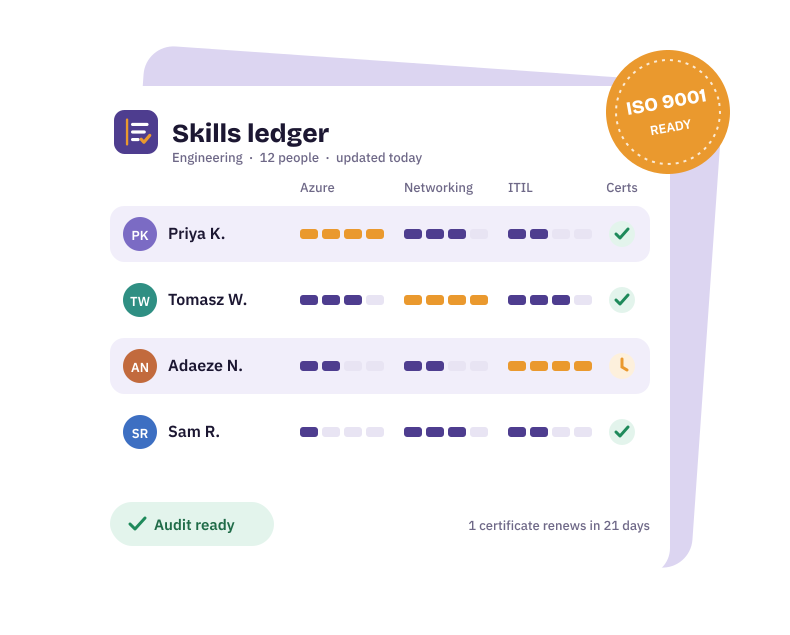
People rate themselves, line managers review and confirm their team's ratings, certificates sit alongside with expiry dates, and anyone can flag a skill they'd like to develop. See skills matrix software.